In an era of relentless ransomware attacks and ever-expanding data volumes, the question of whether to use tape in a modern backup strategy is more relevant than ever. The answer, however, isn't a simple yes or no. It’s a strategic decision that hinges on your organisation's specific needs for recovery speed, data security, and long-term archiving.
Tape storage, once considered outdated, is making a significant comeback for several compelling reasons. Modern tape, particularly the Linear Tape-Open (LTO) format, offers a unique set of advantages that make it a vital part of a resilient data protection strategy.
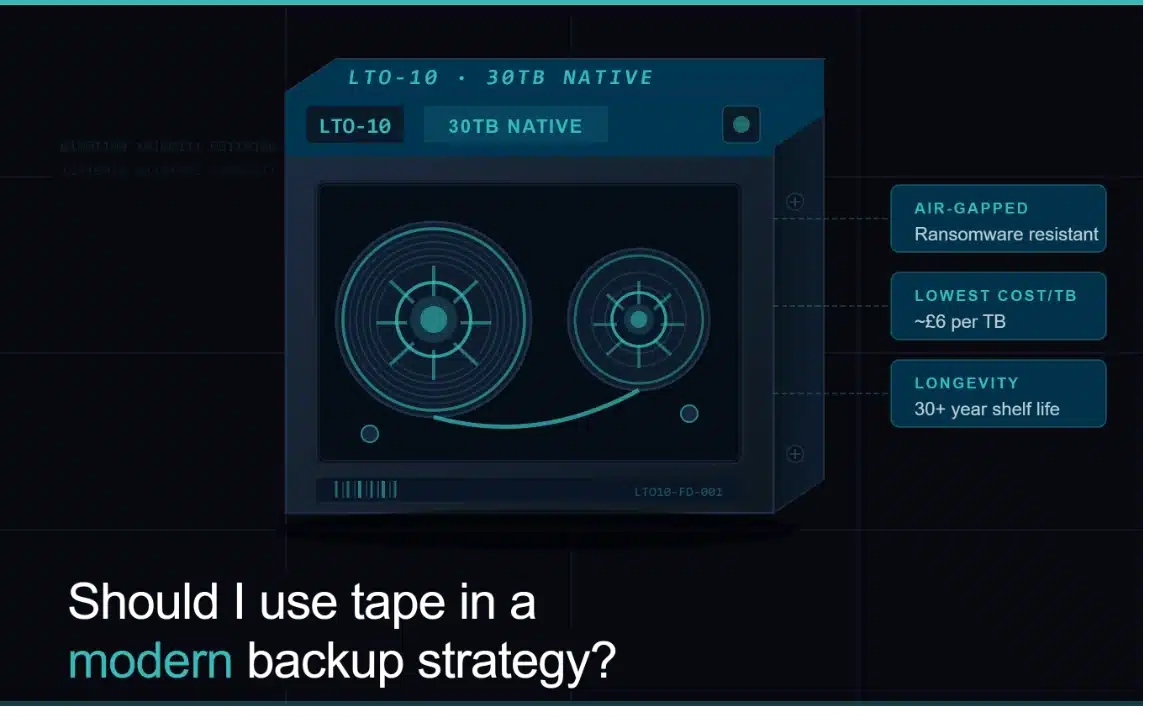
For long-term data retention and archiving, tape is the undisputed cost champion. The cost per terabyte is significantly lower than disk-based storage. For organisations managing massive datasets, this economic advantage is difficult to ignore. LTO-10 tapes, for example, can store 30 TB of uncompressed data at a very low cost, and the trajectory for tape suggests this cost-efficiency will only improve with future generations.
Perhaps the most critical advantage of tape in today's threat landscape is the "air gap". A tape cartridge, when removed from the tape drive and stored offline, is completely disconnected from the network. This makes it inherently immune to ransomware, malware, and other cyberattacks that target online storage. This physical disconnection provides a level of security that even the most sophisticated online storage cannot match, making tape a "last line of Defence". Many experts recommend incorporating an offline copy into your backup strategy, aligning with the 3-2-1-1-0 rule, which adds an offline and verified copy to the traditional 3-2-1 approach.
Tape media is incredibly durable, with a shelf life of 30 years or more under proper storage conditions, far exceeding the lifespan of hard disk drives. Furthermore, when stored on a shelf, a tape cartridge consumes zero power, making it a highly energy-efficient and sustainable storage option, especially important for "cold" data that is infrequently accessed.
A common misconception is that tape is slow. Modern LTO drives can write data at speeds of up to 400 MB per second, which is comparable to or faster than many standard hard drives. While tape is sequential access and not suited for instant file retrieval, its performance for large, bulk restore operations is robust and predictable.
Despite its strengths, tape also presents significant challenges that make it unsuitable as a primary or sole backup solution for many modern environments.
Tape's sequential nature and its offline status, while a security boon, become a liability during a disaster recovery scenario. Restoring data from tape is inherently slower than restoring from disk, and recovery timelines can stretch from hours to days, especially when multiple tapes are involved. This can severely impact business continuity. Additionally, the need for physical handling—loading, transporting, and managing tapes introduces logistical delays and operational complexity.
Today's IT environments are characterised by rapidly changing data, cloud-native applications, and a low tolerance for downtime. Tape backup was not designed for this paradigm. It struggles with:
- Frequent Data Changes: Constant data changes lead to long backup windows and increased operational bottlenecks.
- Cloud and SaaS Incompatibility: Many modern platforms are not designed to back up directly to tape, requiring complex, multi-step processes. Whilst this has been an issue in the past many tape devices now directly support "S3 to tape", which means your tape now appears as one large localised cloud.
- Granular Restores: Partial or file-level restores are difficult and time-consuming, forcing teams to restore entire tapes to recover a single file.
Tape backup can be dependent on specialised staff who understand the hardware, rotation schedules, and restore procedures. If these individuals are unavailable during an incident, recovery efforts can stall. Furthermore, physical media is subject to damage, loss, and degradation over time. If restore testing is not performed regularly, you may discover that your supposedly secure backups are corrupt or unusable only when you need them most.
The debate isn't about choosing between tape and other technologies; it's about understanding where tape fits best. For the vast majority of organisations, the most effective approach is a hybrid backup strategy.
- Use fast disks: With storage systems that fully support immutability against ransomware. By doing this you avoid the performance penalty of restoring data from the cloud and any hidden API charges and meeting Recovery Time Objectives (RTOs) for your most critical data where rapid restoration is paramount
- Use the cloud for: Secondary backups where data is protected offsite in immutable buckets, in case your site has been hit by ransomware.
- Use tape for: Restoring large volumes of data if your IT systems have been paralysed by a ransomware attack. Restoring data from tape is far faster than any cloud. The tape device and tapes could be taken to a DR site; data could be restored to storage and servers that haven’t been infected and operations are up and running in double quick time.
In addition, you could also use tape for long-term archival of data that is infrequently accessed, compliance and regulatory retention, and as a cyber-resilient "insurance policy" thanks to its air-gapped, immutable nature.
In this model, tape is not the first line of Defence but the last. It is the copy of your data that remains safe even if all other copies—primary, backup, and cloud are compromised. This approach allows you to balance the need for fast recovery with the critical requirement for secure, long-term data preservation. Ultimately, whether to integrate tape into your modern backup strategy is not a question of "if" you should use it, but "where" it will provide the most value.

© 2026 LTO Ultrium Tape Storage | Enterprise LTO Tapes & Tape Storage Solutions
Worldwide Shipping Available
Smarter, strategic thinking.